March 22, 2011
Winning the NCAA Tournament: Stars or Teams?
We seem to run into this debate every March, and this year is no different. What makes a winning tournament team? A balanced, defensive minded squad who focuses on fundamentals? Or is it the fast-paced, athletic, offensive style that wins championships? Usually, we find that a mixture of these wins the prize in April (April? C'mon guys).
But maybe a better debate would be Star vs. Teams: which wins championships more often?
Now, having a team filled with stars will definitely improve your chances at winning a championship (in college at least), but I'm talking specifically about a star-run team (looking at you Kemba, Jimmer, Zona's Derrick Williams) vs. the prototypical Kansas, Ohio State and Florida State (defensive) modes.
Let's say you are a coach. You are given the option of selecting a game-changer like Walker, or you are given a bunch of blue-chip athletes to build a team around. Which would you choose? I'm sure most of your would take the blue-chippers as basketball is played by 5 at a time. But let me argue for the other side.
Take Uconn (as Kemba's impact on the basketball world seems to be a significant one). A team that a year ago lost to Virginia Tech in the NIT second round, and a final four loser to Michigan State the year prior, Connecticut was definitely full of mixed feelings and questions. The one constant during these two seasons? Kemba Walker... But as a second, third, fourth option. When Kemba became THE MAN, Connecticut followed; for in college athletics, a big time player makes everyone around him better. College athletes (and students in general) are a strange mixture of energy and complacency, they always want to be the first but sometimes won't act until they see an example of how to act. This idea follows the same path with Uconn. They had the talent, they had the players, they just didn't have the leader, and sometimes a leader, a star, is exactly what you need to win.
Look also at Jimmer Fredette at BYU. He was an absolute monster in last year's first round game again Florida (a rematch I am quite looking forward to in the coming week) and single-handedly carried his team to the NCAA tournament last year. This year? His team seems to understand the urgency and ability of their star and have stepped up mightily.
As an opposing coach, what do you do with a star player? You have to spend a lot of time game planning to shut him down. And admist all of that effort, it is usually another player who steps up to enable the star to win it all. And we see this time and time again in America's greatest tournament.
And this leads us to Duke. Probably the most loved/hated team in America, because year in and year out, it wins. Wins. Wins. Wins. And with star players? Sometimes. But more often than not, it is a well coached team who plays within themselves to get the wins. And in the greatest counter-argument of all to star players, Duke reveals championship banners with a well-rounded team. But lost in all of the "team" concept Duke produces, people forget to realize... the ENTIRE TEAM is packed with stars.
So I guess the answer to the debate are players. Players win you championships. Good players give you a better chance than poor players, and a Star gives you better chance than no star.
If you ask me, I'll take the Star-filled team, but I'm a sucker for underdogs, so give me a gig and I'll bring my team to victory, no matter how good.
February 24, 2011
Cherry and White and Dead All Over

I’ve seen college kids do some crazy things. I’ve seen college kids rag on teams, storm courts, and hoist players up on their shoulders like childhood heroes. But until Sunday, I’d never seen anything quite as crazy as the Temple University student section.
Touted on a Facebook event page for weeks, and in the planning stages for months, the Cherry Crusade, organizers of the Temple student section decided to throw a funeral for archrival St. Joseph University’s mascot, the Hawk that never stops flapping its wings.
Being a public school, we take things to heart and play with an enormous chip on our shoulders. We have to prove ourselves every day, so when private schools come in acting better than us, we tend to treat them with nothing less than brutality.
Lining up for hours outside of the Liacouras Center in frigid temperatures, one might have believed it was a gothic convention or Halloween party. Students dressed as priests, pall-bearers, and mourners ready to bury the Hawk, once and for all. Upon entering the arena, students received black t-shirts reading “R.I.P. THE HAWK,” a testament to the day’s agenda. Others passed out mock programs “In Remembrance of the Hawk,” listing the dates of the past eight games Temple won, and a list of players who were either suspended or transferred from Joe’s.
Only seating 10,000, the arena is always loud, but before the game, the anticipation was audible. As the SJU players were introduced, the student section kneeled, praying for their loss. Just before tip-off, the arena erupted as a cardboard casket was marched in donning a Jameer Nelson college jersey. One student dressed as the grim reaper guarded the casket through the entire matchup.
Rollout posters, a staple of Big Five basketball to taunt the other team, were especially stinging during the matchup. Displaying SJU’s Five Stages of Grief, they marched out, much to the awe of the other fans in attendance who clamored to take pictures of them. “Denial: 55 years of chanting ‘The Hawk Will Never Die!’” “Anger: Promising Recruits, 7-18 Record,”

“Bargaining: Phil Martelli's Severance Package,” “Depression: No Atlantic City two straight years,” and finally “AccepTance: 9 IN A ROW” perfectly captured the scope of the event.
The game was less than exciting, with Temple dominating the entire time. Sophomore Rahlir Jefferson turned out an outstanding performance, junior Juan Fernandez had stellar shot selection, and senior Lavoy Allen shattered the school’s all-time rebounding record. The Owls easily won, 66-52, to bury their A-10 rivals, if not their mascot.
Every school has their winner’s chant. Some schools sing “hey, hey, goodbye.” Other schools sing their alma mater. At Temple, we scream our “I Believe” chant. It’s what fans look forward to watching us do, and it seals the win with an immense fiery passion. As an alum screams “I” at the student section, we repeat. The alum then will scream “I Believe,” which we repeat, until finally, the entire section is bouncing, clapping, and screaming “I believe that we have won.” For the final spade in the Hawk’s grave, we substituted our quintessential chant to scream, “I believe the Hawk has died.”
I’ve been to some
crazy college games. I’ve stormed the court twice, twice more than any other person usually gets to do. But never, never, had I been to an event as well-planned, as thought-out, as carried-through, and most importantly, passionate as the Funeral of the Hawk. I certainly give my kudos to the Cherry Crusade on this one.The Owls will look to make a decent run in the NCAA tournament this year and four-peat as Atlantic-10 Champions, and regardless of how far they go, they can certainly rest assuredly that they have a fan base like the Cherry and White. Some schools make signs for their players. Some schools have cheers for their players. Some schools congratulate their players on game day. I don’t know many schools that would kill the opposing team’s mascot for their players. But hey, that’s what college sports are for.
For those of you that didn't get to see the pictures from the game, enjoy. Thanks to the 700 level for the photos.
January 29, 2011
Zero Became My Hero

Then the announcers told the heartwrenching story of Thomas Robinson, forward for Kansas University, who lost his mother, grandmother, and grandfather within three weeks. Lisa Robinson, mother of Thomas, passed away at age 37 from an apparent heart attack on January 21, the day before Kansas took on 10th ranked Texas, according to ESPN. Thomas, though grieving, stepped onto the court, and played the game. Teammates and coaches all flew to Washington, D.C. to support Robinson at the funerals of his grandmother and mother.
Tonight, signs in support of Robinson littered the stands and the players donned patches with “LR” in memory of Robinson’s mother. Coaches gave hugs and players remained encouraging. The entire game didn’t have your typical rivalry feel. Instead, it was an atmosphere of healing, and one where spectators, athletes, and coaches alike remembered that basketball is just a game we play.
The most inspiring moment was when Robinson, number 0, told why he stepped onto the court that night. He said he did it for his seven year old sister, to show her that life goes on, things get better, and they, together, can overcome this tragedy. The roars at the Jayhawks’ Allen Fieldhouse are always thunderous, but as Robinson touched the ball, scored a basket, or stepped off the court, they became deafening, letting Robinson know the KU family was behind him.
While I was cheering for K-State at the outset of the game, quickly, I found myself rooting for the one player on the court that made the biggest impact. Perhaps Robinson didn’t score the most points, or have the most rebounds, or make the largest on-court contribution, but he outshined all the other players with his heart and determination to play the game, to transcend his grief.
To know that there are some things that transcend the sport, make it that more meaningful. To know that the sport can help you work through the most difficult moments in your life, that is why we’re drawn to them. For Robinson, basketball is still just a game. But it’s the bonds he’s formed with the game and with those who play it with him that allows him to use the game to heal. Tonight was a poignant example of that. Rivalry, rankings, rushing the court mean naught, but helping a teammate heal, regardless of the color of their jersey, was truly the point of the contest.
December 10, 2010
Templetown Takeover

ESPN gifted the match with a nationally-televised, primetime slot. The anticipation was high. The question on campus all day long was “Hey, do you think we can win this?” Fans started lining up four hours before tip-off to make sure they got the best seats in the house.
Temple had something to prove. After starting out the season in the top 25, they lost their ranking with a few sloppy performances. Back on the home court for the first time in nearly a month and facing a formidable opponent, they were intent on putting up a battle.
And that they did. Junior Ramone Moore put up 30 points, and even the stat sheets couldn’t show how well he contained Georgetown standout Chris Wright. Juan Fernandez, Lavoy Allen, and Rahlir Jefferson all put up incredible efforts to help Templetown takedown the Hoyas. The Owls never trailed in the game and clutched the 68-65 win.
Maybe it was the feeling of redemption. Maybe it was the feeling of vindication or elation or pure adrenaline. Maybe it was the age-old expectation that a non-ranked team beating a ranked team deserves. But as soon as the final buzzer sounded, the student section emptied out onto the maple of the Liacouras Center. And as the famous “I Believe” chant began, it was still sinking in. TU students have shirts, have signs, have posters, have schedule magnets, have headlines, have keychains, have spirit. But it was still sinking in.
Temple still has a long road ahead with tough matchups against Villanova, St. Joe’s, and Duke. With this huge momentum shift, however, the Owls will carry an unmatched confidence. For the 9,000 fans who witnessed the upset last night, it was a game that won’t soon be forgotten. The deafening roars provided the soundtrack to a team fueled by passion and spirit. As that backboard lit red and the clock expired, the collective sigh of relief in the building was tangible before the upsurge of cheers.
The shirts last night read “I think you hear us coming.” Well, by George (-town), I certainly think they do now.
December 7, 2010
Vindicated Vick-adelphia

August 1, 2010
One Phan Who's Overjoyed About Oswalt

Throughout the last decade, Roy Oswalt’s been one of those pitchers. Understated, underestimated, under the radar. To everyone outside of Houston, Texas, that is.
Living out half my childhood in Houston, I was one of those Oswalt fans. Roy-O was dominating in an era of Astros baseball that ranked among the best. Biggio, Bagwell, Berkman, Oswalt. I got to grow up watching legends play ball. To bring a little piece of that to my current city is terribly exciting.
Talking the stats, Oswalt’s up there with the cream of the crop. Over his decade-long career, he’s had two 20 win seasons and an ERA that consistently hangs around 3. Oswalt’s got the team mentality, the selflessness, the passion that it takes to succeed in this game. A three-time All-Star, Oswalt just wants you to let him play ball. He wants to give a ballclub a chance to win. He’s a quick pitcher, a fast worker, and a great bunter. He’ll get the work done.
The main sentiment around Philly is that if the Phillies so badly wanted to bring an ace to their staff, they should have kept Cliff Lee. They wouldn’t have had the space and cap to bring around Roy Halladay without Cliff Lee gone. And if Lee would’ve had a similar season had he stayed in Philly, he’d have been a dead weight to an already sinking team.
For all the skeptical Phillies phans, baseball in Houston’s a lot like baseball in Philly. It’s tough. It’s passionate. And you’ll go years without a successful club. From top of the National League to nobodies. A city that’s never won a World Series. Trust me, Oswalt knows the frustration Philly’s felt for years. Oswalt’s a perfect fit for this Philly club. Just when they need a little push to make it into the postseason, he’s there to deliver. Don’t discount this guy. He’s still got the stuff. He’ll prove it to you.
Philly phans, I know you’re critical. I know players have to earn your respect. It wouldn’t be Philly without that atmosphere. Just hear me out, I’ve watched the guy loyally for years. He’ll bring some great energy to this city. Get ready, Philly, and be prepared to enjoy Roy-O’s runs.
And when the Phils make a decent postseason run thanks to their new addition, you don’t have to come back and tell me I told you so.
July 7, 2010
LeBron Joins the Circus

I remember a time when, to LeBron James, playing for his hometown Cavs meant everything. And the past few years, money became more and more his deciding factor. In 2003 when LeBron left high school and graduated to the big leagues, he was all the rage across the country. This “King James” was the next Wilt Chamberlain, the next Doc J, the next Kobe. Kids all around the world wore the jersey of a kid who had just stepped onto the scene. Fans put the future of the league directly into his hands. And he took it, and ran with it.
He’s certainly living up the fame and fortune that have fallen into his lap. And his free agency will certainly be the biggest story this offseason. No doubt, LeBron knew that. He’s had teams courting him, left and right, and wants a city that will surround him with stars, but where his will still shine the brightest. Planned around the 4th of July, around the World Cup, even around the Coney Island hot-dog-eating-contest, his strategy gives him the most media coverage possible. So his announcement will come on ESPN tomorrow night with its own hour-long special leading up to the live decision. Make no mistake, LeBron is cashing in on every ounce of attention the American public is willing to give him.
For a guy that’s scored some 15,000 points in his first six years in the league so far, he might deserve the hype that trails him. But is it completely necessary to track the every move of one player, every meeting he attends, and every deal put on the table? I have to agree with Russakoff, it is our fault. LeBron hopped onto this scene as a kid, and we only gave him the attention any superstar would expect. So while this whole event (it’s a free agency decision…let’s not forget that…) may be quickly turning into a circus, let’s hope that the free agents in every sport don’t follow suit.
LeBron, just tell the world where you’re going and be done with it. I’m only going to check online when this whole thing’s over anyway. Wait, you didn’t actually think I was going to watch your hour-long special now, did you, LeBron?
July 6, 2010
New York Senate Uses MMA To Cut Deficit And Help State Budget
On June 16th, the New York State Senate passed a bill to legalize mix martial arts in the state of the New York. It still needs to be approved by the State Assembly in order to be a law, but passing the State Senate is a big deal for both the Empire State and Mixed Martial Arts. MMA, while being legal in many other states around the country, has been banned in New York since the mid-nineties which meant that prime venues like Madison Square Garden in New York City and the 50,000 seat Carrier Dome in Syracuse were off limits for holding MMA events. This would no longer be the case if the assembly passes the bill. Dozens of great venues in the state would be open to new events that would help grow the already popular sport of MMA even further while helping the state make money.
It's hard to imagine that New York state education and other programs would be a direct beneficiary of MMA, but that would be the exact case if the bill passes. Mixed Martial Arts is one of the most popular sports in the country and its popularity grows with every passing day. This would mean that the dozens of sold out shows that MMA has every year would finally bring revenue to New York.
To put the financial benefits of legalizing MMA into perspective, just look at the numbers of the sport according to Fannation.com:
• $340. That was the average ticket price of UFC 81 at the MGM Grand. While this may seem like a lot, people are paying it to see their favorite matches. One could imagine the amount of tax money that would go to directly financing state programs and projects. Also a factor to consider is the amount of revenue brought in by people coming from all across the country for the events that would be spending money on food and accommodations.
• 170 countries broadcast UFC and other MMA events, which brings in huge promotion for some not as well known New York state cities that may hold an event.
• MMA industries like UFC have gone from million dollar companies to billion dollar companies in less than a decade showing just how popular this sport really can be.
These numbers don't even account for New York based MMA gyms that will see new revenue to help train local fighters in a sport that was once outlawed in their home state. This will directly correlate with an increase in local sales of MMA gear, like MMA gloves. Hundreds of retailers will benefit from this boost. The increase in local fan-base will have a direct impact on the sale of MMA t-shirts that display their favorite fighter or industry brand. They have become a hot commodity as the sport has increased in popularity. There is no doubt that the reach of the bill, if passed, is not just huge for New York but is greatly important to its many citizens that are struggling because of the bad economy.
The state and Governor David Paterson have estimated that allowing the sport to be legalized would bring in an extra $2 million after two years for the state's $8 billion deficit and studies have shown that holding an event in Madison Square Garden would generate $11.3 million in economic activity. This may not seem like a lot but it's a step in the right direction for the state. This bill is something that New York has been trying to do for over the last two years but has failed in doing so. Even if the bill doesn't pass the assembly, Governor Paterson has stated he will include it in his emergency extender bill giving it another way to be legalized. Yet, right now is the time for the passing of this bill because now MMA is closer than it's ever been to being a popular and helpful force in the Empire State.
June 26, 2010
Fixing the NBA Parity Problems
Although fans of large market teams may disagree by the product on the field, large market teams have more money to spend on the risky middle relievers. They are able to pay a lefty specialist. They are able to create a bullpen around their opponents. Small market teams have to develop failed starters into people who can pitch a few innings in the middle of the games. And even though the bullpen plays an important role in modern day baseball, teams can win in spite of their bullpen. For this reason, small market teams have a better chance at winning pennants. Don't believe me? The '97 and '03 Marlins, the '01 Diamondbacks, and to some extent the '05 White Sox have shown how to win a world series in a small market.
Baseball's minor league system is the best in sports. This is partially because of the multitude of rich baseball players around in the world, but it is also because of the marketability of baseball. People enjoy the atmosphere of baseball no matter if it is low A or the major leagues. This business opportunity enables players to grow in front of fans and play for a team in hopes of winning a championship at any level. Using this model, small market teams have the ability to cultivate their own talent and save money by not having to sign big free agents.
Also, because baseball talent is all very close in terms of the average player, and because the game is a game of inches, teams are generally closer in terms of talent than other sports. A team of superstars, while they may look better and more overpowering, are only a degree better than their lesser counterparts. Using these laws of baseball the Marlins and Diamondbacks were able to cultivate talent, make some free agent signings to plug holes, and consequently win championships. And in the case of the Marlins especially, trade away all their talent for more prospects to go ahead and do it again another year.
So in reality, baseball gets unfair criticism. Just take a look at this year's standings. Every single division has a race going on and only a handful of teams are out of it at this point.
But basketball on another hand is a parity disaster. Unfortunately the parity problems are more salary tax based than anything else, but unlike baseball they are unable to win in spite of financial issues. The NBA is quite possibly the only league in the world where it is sometimes considered a BAD thing to receive talent. Most of the time teams are more concerned with saving salary cap, or staying under the salary tax, thereby shipping quality players to other teams for salary relief. Expiring contracts are treated like gold, as the more players you have coming off the books next year the more players you can sign in the future. The problem with this method of business is that teams on the bottom generally stay there. The bad teams cannot afford to sign free agents because of their salary tax issues, but at the same time they are not able to trade for the expiring contracts because they don't have enough current salary cap to take them on for that year. Also, teams stuck in the losing mode have to rely on the draft, a process that can take years to pay off as there are only 2 rounds (not even considering all of the busts that enter the league). Sure, new teams come up each year, but almost every year the same teams are at the bottom. Until the NBA figures out a new method to help the floundering teams find it's feet again, they will continue to lie at the bottom.
How can the NBA fix this problem? Get rid of the lottery. I know that they do it so teams don't start tanking at the end of the year (teams do it anyways), but do you really think it's a good idea to risk having the worst team in the league not get the best player? The only way a bad team can get better is if they get new talent and the only way that can happen is if they get the top pick, it's that simple. Maybe a straight draft by standings position won't work, but the lottery has got to go.
Also the NBA should explore a owner sharing system (revenue sharing) that the NFL has in place. Pool money together to make sure the salary cap is a fair number for all markets. This method is a very difficult one to maintain and make work, but it is something good to look into.
The final thing the NBA has to explore is to improve it's D-League. We have enough basketball talent in this country that we could make a very good minor league system. As it is now the D-league is an underground train coming out only in the rare occasion that the NBA calls up a player. We are losing too many good players to European countries when we can just as easily keep them here and give them a real shot at the NBA. If the D-league was a more legitimate league teams would pay more attention to them and make more moves in house, saving salary cap, and helping out smaller market teams build from the inside out.
The NBA has some exploring to do, but I know this: If things stay the way they are, we will be seeing a lot of Celtics-Lakers in years to come. And to the large market fans, that is not a bad thing.
June 10, 2010
U.S. World Cup Preview Part II: Legitimate Expectations
Goalkeepers
Quality goalkeeping has often been a strength of U.S. teams whether it be Kasey Keller or Brad Friedel. Expect this year to be no different with star goalkeeper Tim Howard. Last summer's Confederations Cup showed just how far a team can advance with a red hot keeper with Tim Howard leading the way to a second place finish. The weakness of Howard used to be his inconsistent play on services into the box. He has fine-tuned his game to read those crosses better though now and become a staple of the Everton defense. The U.S. boasts one of the deepest goalkeeping trios and while that starts with Howard they are not short of options behind him. If the worst were to happen and Howard were to go down Marcus Hahnemann would most likely step in. The 37-year-old American debuted back in '94 but only began to see more time in '03. Next in line would be Brad Guzan, a steady, but unspectacular keeper.
Defense
The biggest fear the U.S. may have this summer is a suspect defense leaking goals. A lot of that will have to do with the health of Oguchi Onyewu and to a lesser extenxt Carlos Bocanegra. The U.S. defense is much stronger when they can put team captain Bocanegra on the left and allow him some freedom to push forward. However, a lot of that depends on whether Onyewu is good to go and what point he is fit to play. Onyewu has yet to play a full 90 minutes since tearing his patellar tendon seven months ago just when he was starting to get quality time for world renown AC Milan. When healthy Onyewu is the U.S.'s best defender due to his shere size and physical play coupled with his ability to read the game so effectively. If Onyewu is healthy he will be paired with a hard-nosed tackler in Jay DeMerit. The Watford defender looks so much more comfortable when he has Onyewu alongside him. However, if Onyewu is unable to go come Saturday the U.S. may turn to University of Maryland product Clarence Goodson. Goodson is excellent in the air and couple be key to shutting down or at the very least slowing down the effectiveness of an aerial threat such as Peter Crouch. The problem is that DeMerit's play seems to suffer when paired along with Goodson whether it be a lack of chemistry or whether their styles do not mesh. In that case the Bob Bradley may push Bocanegra into the middle and continue the perennial black hole at left back for the U.S. In such a case it would come down to Jonathan Spector or Jonathan Bornstein. Spector played every minute of last summer's Confederation's Cup and provided some very promising services. However, he is clearly more comfortable on the right as exhibited by his inconsistent play at left back for West Ham with past season. Hopefully the last resort for the U.S. is converted forward Bornstein. Bornstein has excellent speed and can be dangerous at times pushing forward, but too often his caught out of position and is very susceptible to the counter attack: a weakness the U.S. cannot afford with their defend and counter style of play. The last of the U.S. defenders is longtime Hannover 96 defender Steve Cherundolo who is appearing in his third World Cup for the Yanks. Cherundolo is an small, but scrappy defender who provides steady play to a largely inconsistent back line. Cherundolo should get the nod over Spector going into the opener against England.
Midfield
For the U.S. to score goals they will need strong wing play from veterans Landon Donovan and Clint Dempsey. Unlike last go round, Donovan has embraced the expectations for both him and the team. He has finally silenced the doubters with strong play for Fulham in the Premiership while on loan. On the other wing Clint Dempsey may just be the U.S.'s most dangerous weapon. Due to a surefire partner for Altidore there has been talk of moving Dempsey up top. But watching Clint's play it is clear he is much more comfortable and dangerous attacking people along the wing where he has freedom instead of being a stationary target man up top. However, Dempsey will surely see sometime up top late in games to provide a spark or shut the door as he did against Spain in the U.S.'s monumental upset last summer. Unlike the wingers, the central midfield is not so solidified. The one staple is Michael Bradley who will in all liklihood be paired with various partners depending on the opponent and situation. While Bradley's passing is suspect at times, he brings excellent pace to the game and is not afraid to do the dirty work. He evens provides some offense with his ability to be in the right place at the right time with nothing pretty about it. Bradley will need to avoid missing the consequential match due to excessive bookings as he has done in the 2007 CONCOCAF Gold Cup and the 2009 Confederations Cup. Ricardo Clark will most likely start alongside Bradley against the English squad. Clark is a gritty player who plays solid defense but is no real offensive threat. An intriguing name and one that is growing in popularity is Jose Torres. When Torres has been given the opportunity in recent play he has demonstrated outstanding play. He is very viable on the attack and shown an ability to win crucial tackles, a weakness often sighted by critics. With the opportunity and strong performance Torres could win himself a big transfer this summer. Two other names that could have impact are fellow youngsters Stuart Holden and Benny Feilhaber. Both have played strong at times and disappeared at others. Their inconsistent play will in all likelihood prevent them from securing a starting spot. In a close game in need of a game changer though they could provide that spark off the bench. Another young and rising player is Maurice Edu. Edu while not known for his offense has scored a handful of goals highlighted by his game winner against Glascow Rangers in the Old Firm. Edu plays a solid defensive midfield and can play center back in a pinch. The last of the midfielders is DeMarcus Beasley. Less than a year ago Beasley was exiled from international play for his largely inconsistent form and failure to attack defenders. He earned his way onto this roster and although not a game changer, he does provide experience to a fairly youthful squad.
Forwards
The U.S. striking force is headlined by a real American star in Jozy Altidore. The budding star will need to provide timely goals for the U.S. to succeed. The question really is who to pair with Altidore since Charlie Davies was not fit to make the roster. The choice looks more and more like it will be Edson Buddle. He was scoring goals at will in the MLS and that earned him a shot on the team. Up until the Atrailia friendly no striker had nailed down the spot opening the door for Buddle who put his goal scoring on display with two goals. A real dynamic player could be speedster in Robbie Findley. Findley's addition to the roster shows the emphasis Bob Bradley is placing on speed. Findley can blow by defenders already, imagine a fresh Findley running down a ball against a tired defender. The one thing Findley will need to do is finish his opportunities though. The U.S. defend and counter strategy cannot afford to waste opportunities. The last of the forwards is surprise golden boot winner of Mexico's premier division Herculez Gomez. He has scored his fair share of timely goals and will look to build on that once the real action starts.
So what are legitimate expectations for this youthful squad? Anything short of advancing to the knockout stage will be utter disappointment and could set American soccer back. The team is certainly not short of athletic players and much will ride on the ability to convert chances at a high percentage and not give up soft goals. The Americans will probably finish behind England in the group. That would match them up with the winner of Group C, probably Germany. However, the injury to star midfielder Michael Ballack has created questions for a German side that may not win the group so easily anymore. In the end anything can happen once you reach the knockout stage. If the U.S. wins the group they would have a much easy path and the semi-finals would not be out of the question. Ultimately, this is guesswork and we really will not know what to expect until we see the teams perform. A quarterfinal appearance would be big to boost American soccer and would largely be seen as a success. The question is whether the U.S. can meet expectations now that they are higher than ever.
June 9, 2010
Stephen Strasburg: From the Stadium
But seriously, could I really expect anything from him on his first ever start in a city on the other side of the country? I could, but to be honest I didn't expect what he showed me. Did anyone?
With a Nationals record 14 strikeouts, 0 BBs (0!), and 7 innings pitched throwing less than 100 pitches, he dazzled. Sure everyone joked about how amazing he was going to be and how he is the best we have ever seen... could he be?
I know for one I am not going to get rid of that ticket just in case he becomes who he is touted to be.
But I know you don't really care about the fact that I was there (and on tv and on mlb.com highlights-- the 2:02 mark of the Mr. Precedent recap), so I'll give you my thoughts on his performance.
-His curveball is nasty. Nasty and he went to it early and often. And he learned pretty quickly that throwing too many breaking balls results in bad results. Delwyn Young's homerun (after multiple breaking balls in the at bat) came off of a breaking ball. He has to learn (and I have no doubt he will) to mix pitches better. He primarily throws only fastballs and curveballs, with an occasional change-up and what some are calling a dipping or rising 4 seam fastball (his fastball either moves up in the zone or drops like a breaking ball, only at 98+ mph). So with so few pitches he needs to figure out a method to mix and match to always keep the hitters off guard.
-He can throw. He consistently hit upper 90's and even 101 mph at one point and the hitters looked absolutely helpless. When you have a fastball as good as his, you can tend to rely solely on it, but he did mix in breaking balls (but like I said before to a fault). He definitely went to a high, rising fast ball as his out pitch and it seemed to work fairly well until the middle innings where the Pirates started to keen in on it.
-He has poise. He ended the game with 7 straight strikeouts and battled back from multiple 3 ball counts and also got out of a few jams (he only let up 4 hits, so there wasn't much going on on the base paths).
We truly won't know how good he is until he is tested and until he has faced the league a few times, but it was definitely a night that all will remember.
Could this be the start of a legend? Maybe. But I know for a fact that that was one of the greatest debuts I have ever witnessed.
June 1, 2010
U.S. World Cup Preview Part I: The Rebirth of a Soccer Nation

It is that time again. Every four years the greatest sporting event occurs (sorry Olympics). We are now just a mere 10 days away from Mexico and South Africa kicking off in Johannesburg at 10:00 A.M. EST. The biggest question on everyone’s mind in the U.S. is which team we will see. Will we see the improbable run to the Confederation’s Cup final last summer? Or will we relive the disappointment of the 2006 World Cup lamented by a very poor team effort. We seem to never know what you get with U.S. soccer. The rebirth of soccer took place in 1990. In the 1990 World Cup the U.S. failed to record a win, dropping all three games to Czechoslovakia, Italy, and Austria. Then in the 1994 the U.S. advanced to the knockout stage where they feel to eventual champion Brazil 1-0 that featured a red card for both sides. Then the 1998 World Cup came along. Expectations were high, but not unrealistic. The U.S. put forth a pitiful effort failing to emerge from a group that while it included Germany, also featured the pitiful Yugoslavia and Iran. To make matters worse the U.S. recorded a single goal in three games. Then along came the 2002 World Cup. The winner of the 2002 Gold Cup gave U.S. soccer fans a glimmer of hope. However, they many saw firsthand the demise of past teams. The U.S. put together a sparkling run that ended in a controversial 1-0 loss at the hands of eventual runner-up Germany in the quarterfinals where a clear handball on the goal line by Frings prevented a game-tying U.S. goal. As the 2006 World Cup approached the U.S. team had extremely high expectations, perhaps a bit unrealistic as well. The U.S. drew a deadly group of Czech Republic, Italy, and Ghana. This team had its ups and downs in the tournament looking pitiful against the Czech but played exceptional against eventual Italian champions to record a 1-1 draw in a hard fought match that featured three red cards. While it seemed unlikely for the U.S. to advance heading into the final group game against Ghana there was a chance. U.S. just needed to beat Ghana and get help from the Azzuri. The Azzuri delivered with a 2-0 win against the Czech and all the U.S. needed was a win. Instead then fell to Ghana in disappointing fashion that included a mysterious penalty kick called against the U.S. The U.S. team has certainly had its ups and downs; the question is which team will we see in South Africa?
May 31, 2010
Danny Carcillo, The Little Punk

Danny Carcillo. The little punk. He’s like the Philadelphia Flyers in a nutshell. Little guy, big ol’ fight. Every time he touches the ice, it’s a jab here and some words there. But he gets the job done. Every time he graces my television screen, my cousin and I are compelled to yell “Danny Carcillo, the little punk.” Sure, she works for the Bruins. And sure, I’m a Flyers fan. But the message is the same, and Danny Carcillo, the little punk, embodies these Flyers perfectly.
Mystery in the City of Brotherly Love
April 27, 2010
Laid-Back or Impossible: Ranking the Hardest Sports
High Mental Capacity Required:
1.) Cycling/Track
-Have you ever seen an athlete's eyes when he or she is running the mile? If you are staring into the eyes of one of the best in the world you will get a blank stare back, but not for lack of focus. Actually, it is the complete opposite. Runners are often so in tune with their current race or activity that they are extremely detached from it. Many runners have claimed to feel somewhere else during a race, yet at the same time so in tune with each step, carefully planning the next move. Racing is as much mental as it is physical. Sure, cyclists and runners are some of the most fit athletes in the world, but in order to get a leg up on the competition (legally!) one must be able to ignore the immense pain and discomfort and focus solely on finishing the race. One of the most underrated aspects of racing is the strategic aspect. It isn't just about running or riding in circles or up and down hills, it is about doing it to the best of your ability while minimizing the ability of others. Do you start off fast to wear out other athletes? Do you go on the inside to cut off the angle of those behind you? All of these strategic moves combined with an athlete's unworldly ability to disconnect from the pain make cycling and track the hardest mental sport.
NOTE: The previous also applies to any kind of racing, most notably Swimming and Car racing (yes, it is a real sport, try and do it and you'll see how much you sweat)
2.) Horse Racing
-I am a little bit hesitant to call this a sport because an animal is doing most of the work, but it is widely considered one and it does, in fact require a high mental capacity. Jockeys have to have the whole race planned out beforehand, and then be able to adjust to different circumstances, fitting in tight areas, and making sudden and unanticipated moves. In this sense, it is one of the hardest sports mentally as you always have to be a step ahead of the action and be able to think on your feet in very perilous situations.
Honorable Mention: Swimming, Car Racing, Tennis (go ahead, try being soft)
Toughest Regimental Sports
1.) Boxing/Wrestling
- Every sport has some kind of work-out routine and eating regimen, but these sports are especially difficult. I dare you to try and train like a boxer or wrestler. I'll give you 3 days. You can't make it. They are by far the two hardest sports to prepare for, requiring extreme sacrifices and to-the-limit dedication to make it. Wrestlers and Boxers, constantly trying to stay within a certain weight limit have to constantly check what they are eating, making sure their water weight is at the appropriate level so as to not miss the weigh-in, and thus disqualifying them from the match. On top of all the eating sacrifices, these athletes must undergo some of the toughest training sessions, dealing with speed, agility, and strength. Most sessions are continuous, giving very few opportunities for rest and usually asking for 100% effort at all times. A very tough thing to ask of someone who is also tracking their food intake at all times. You have to be very dedicated or very crazy to be good in the fighting realm, and the best are.
2.) Martial Arts (and MMA)
-This one may be a little off the radar, but in reality, the best of the best Martial Artists have to be extremely dedicated to their work, always working to improve their skills. The amount of time they need to spend improving their core, flexibility, focus, and strength is mind-blowing. Most professional Martial Artists live and breathe their type of fighting; dieting, performing yoga, and working out to become the best Master possible. I am sure that most of us have taken a Martial Arts class at some time in our lives and I know from experience allowing yourself to be thrown is a very difficult thing to overcome, but the best of the best have trained so much it is no longer an issue. Martial Arts, although a bit under the radar in the amount of preparation needed is most definitely a difficult regimental sport. Plus the guys are nuts
Honorable Mention: Gymnastics (very difficult technically and a lot of work before)
Toughest Technical Sports
1.)Soccer
-I'm willing to bet that we have all played Soccer at some point in our lives (ironically, soccer is the number 1 youth sport in the United, but it loses almost all of its participants by high school), but to really PLAY it, you have to have a ridiculous amount of technical skill. Go to Europe, sit in a sea of excited and passionate fans and watch the warm-up. That's it. You don't even need to watch the game to see how skilled these players are (I would highly recommend staying for the game, though). The pace they put on the ball, the way they can control the ball in any situation, and the manipulation they can put on a ball when they shoot is just mind-blowing. Hours and hours of practice on the pitch makes these players some of the most amazing manipulators in sport. Ask them to put the ball through a small opening, they will; tell them to juggle it for 20 minutes, and they will do that too. It is amazing how much technique is involved in such a pure and simple game, but each year more and more technique is added to this already skill-ridden game.
2.) Golf
-This one is pretty obvious, Golf is almost ALL about the technique (you can see this best by watching Charles Barkley swing a golf club. But Golf is built on technique (remember those "these guys are good" commercials?), running on which club to use in which situation and perfectly executing a shot from a spot you may have never been to. Driving, the simplest part of the game is even difficult to do, as you have to manipulate your swing so you hit the ball exactly at the height you wanted to, while still having the ability to aim your swing to a small, thin fairway. All in all, Golf is built on skill and it is one of the most pure forms of skill we can find in the sporting world. It doesn't matter if you are big or small, male or female, it is one of the most universal sports because it is based on skill, something that can be honed by people of all types.
Honorable Mention: Skiing, Snowboarding, Winter X(you need to do it and do it well)
Most Athletic Sports
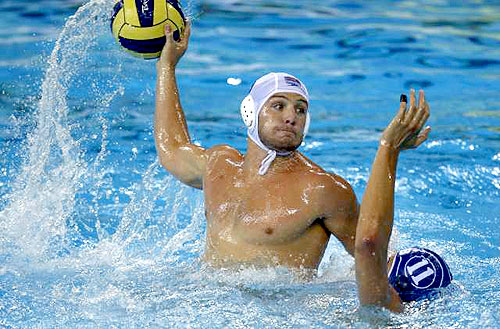
1.) Water Polo
-Are you kidding me? Have you ever seen a Water Polo player? They have a stronger core than any other athletes I have ever seen. The ability to swim, WHILE being kicked, punched, spit at, etc. AND have to be able to pass, shoot, and catch a ball? That is insane! And yet, some people in this world are exceptional at it. The mostly Californian-based sport is a mix between swimming and handball with the goal of getting a volleyball-type ball into a net that is based in the water. The idea that the game is played in a deep pool makes it even worse. The competitors have to tread water the entire time they are not swimming, then swim, oh yeah, and then fend off defenders trying to rip their heads off. Sounds fun.
2.) Basketball
-The ultimate "athlete" sport. You want an athlete? Go get a basketball player. In my opinion if you wanted to start a team in any sport, but you couldn't use athletes who already played that sport, the first place I would look would be in the NBA. These athletes are amazing. They can jump higher than most, they can run faster than a lot of athletes, and although overlooked they have a lot of stamina (they run up to 5 miles during a game... most of it sprinting or fighting for positioning). They are also ridiculously good at reproducing the same mechanic over and over again in free throw shooting and shooting in general. These guys are absolute freaks and if basketball were played in water, basketball would be the most athletic sport.
Honorable Mention: Poorball (please click to learn more about this great sport)
Toughest Sport
1.) Football
-You are either really dumb or really good if you play football. The wear and tear on these players is absolutely ridiculous. Just look at how the game is played. It can be argued that more people have more injuries because of playing football than any other sport (both during and after their careers). Think about it, in a game that revolves around hitting people, and hitting them HARD, it would be very naive to think that injuries don't and won't happen. And what is crazier, is that a lot of the players LOVE that kind of hard-hitting contact, thriving under the adrenaline that comes in with a big hit. These athletes are crazy, but people sure do like it (surpassed baseball as America's number 1 sport), so as long as there are fans, people will continue to get hit.
2.) Rugby
-If football players are dumb, Rugby players are INSANE. They are basically hitting each other with no pads. Now that sounds fun. Not to mention having to scrum before every new possession, oh, and you also have to be a really fast athlete with good stamina. Sounds like a man's sport. But in all seriousness, these guys will go head-into anything without any reservation. They are one of the most fearless group of men that you can find in sports. It's almost like they look for the contact, wanting to be the bruiser, the one initiating the hit so their skill players can score the points. This is not a sport for the faint of heart.
Honorable Mention: Surfing (Those people are absolutely nuts)
Single Hardest Event in Sports
1.) Hitting a baseball.
-The single-hardest thing is sports. Hitting a baseball is difficult not only in the amount of time you have to hit it, but also because of all of the different pitches a pitcher can throw, hitting one is almost impossible. Think of it this way, you have about a half a second to hit a 90 mile per hour fastball. That isn't even close to the 103 mile per hour fastballs than some pitchers can throw, giving you around .3 or .2 seconds to react to it. So in order to hit a fastball, you must make up your mind before the pitch. You have to be able to read what pitch the pitcher will throw and you have to start your string the second you see the ball released from the pitcher's hand. Seems pretty simple right? Wrong. The pitcher never throws it in the same spot and you have to guess a location when you swing. Now take into account an off-speed pitch. So let's say you decide the pitch will be a fastball and you make your mind to swing when the pitcher makes his pitch. Now let's say the pitcher throws a 70 mile per hour change-up. Well, you have just swung before the ball reached home plate! But who can blame you? You had to guess because there is a very low chance of you making contact with a 90+ mph pitch when you don't decide until after he throws it. But to the best of the best, the time slows down and they see the ball like no one else. But those are the select few. Hitting a baseball, is by far, the hardest thing in sports.
2.) The Sport of Hockey
-Baseball may be contain the hardest even in sports, but Hockey as a whole is the hardest sport. Think of it this way. Try ice skating. Pretty tough right? Ok so now ice skate, but this time put a stick in your hand. Ok that's easy enough. Now trying passing or shooting a puck while on ice skates. That's a little tough right? Ok, sorry, one more thing. Try shooting a puck at a goalie with 5 guys coming to slam you into the boards. Yeah, just got a little bit harder. It is amazing how good these guys really are. They have to be able to be world class skaters, they have to be able to shoot (some up to 105 miles per hour), they have to be able to pass, hit, maneuver, stop, start, sprint, all on SKATES!!! It is absolutely insane to think that someone can be so good at doing all of these things at once, but they start at such a young age and just grow and grow as skilled players. This may come as a surprise to some people, but the game of hockey is the single hardest sport.
Honorable Mention: Staying on a bull for 8 seconds (go ahead, try it).
Agree? Disagree? Anything that I left out?
Get at me.
Scott
April 15, 2010
The Opening Week Whirlwind
April 10, 2010
Fantasy Baseball: A New Game
But onto the point of this post. As much as I love the current state of fantasy baseball, it couldn't hurt to change the game to make it stronger and better.
So here are some ideas to improve or change up the game (Note some of these are just ideas to switch it up and may not be the best gameplay):
1.) One of the most interesting parts of fantasy baseball are its multitude of different categories that can be used. But as good as that is, it is also extremely annoying when you join different leagues with different commissioner who have different philosophies on the game. Some commish's like holds, some don't. Some value walks, some don't. It is a crapshoot as to which fantasy team is the best, because each league values different things. As interesting as this gets, the fantasy minds of the world should get together to make a set list of categories so we can really find out which players are the most valuable in the game. This will also help make projections and rankings a little bit more unified, helping people draft better teams and teams closer to their likings.
My suggestion would be to make the following stats across the board:
Hitters:
Average, Runs, Hits, Rbis, SBs, Total Bases, Ks (negative points) and then either Homeruns, Walks, HBP, OR OBP, OPS, SLG(because OPS is a mixture of OBP and SLUG it would seem that this is unnecessary, but because the conversion is not exact, it is an important stat)
The reason for the OR is that OBP, OPS, SLG would be inlcuded in Homeruns, Walks, and HBP, so it just becomes personal prefernce (some people really like seeing homeruns on there, while other people like decimals).
Pitchers:
ERA, Wins, Ks, Innings Pitched, WHIP, Complete Games, L (negative points), Quality Starts, Holds, Saves (if you are really bold, we can substitute ERA with Adjusted Pitching Runs which follows the following equation: APR = IP/9 * (LeagueERA - ERA) which is just a park-adjusted era; and we can substitute Quality Starts with Game Score (Game Score = GS = 50 + 3*IP -2*(H+R+ER)-BB+SO + (+2/each full Inning completed starting with the 5th)). But once again, that is for the bold.
So with these stats universal around the sphere of fantasy, the game will take a much different form.
2.) Leagues that Lock Yearly.
This is a weird one, but something interesting to try. This wouldn't be a very fun league, but it would be interesting to put it aside to see how preseason rankings hold up. You choose a team, set up a lineup and don't change it all year. This way we could get a good reading how much picking up players and trading really does change your team.
3.) Stats that Reset Midyear (idea given to me by Ian).
Just like the minor leagues, the winner of the first half and the winner of the second half in each division make the playoffs. This would be an interesting way of rewarding the fast starters and the strong finishers. This is somewhat opposite to conventional fantasy thinking, but it is something to think about.
4.) Rotating Teams.
Each owner has two teams. Throughout the course of the year the owner is allowed to transfer players to and from both of the teams and allowed to trade/pickup players with other owners in the league. The caveat in this would be, however, that the team that finishes the best wouldn't necessarily win the league. The owner who has the two teams that are in the highest position would win the league. For example is someone finished 2nd and 4th and the 1st and 3rd positions are two different owners, that team would win. This way, we could see who can successfully manage two teams to make them as even as possible.
5.) Leagues that add multipliers based on situations
Player A goes 4/5 with 5 rbis in a blowout 15-7 loss. Player B goes 3/4 with a gamewinning 2rbi double in a 4-3 win. Who was more valuable to their team that day? Well in the case of a league that adds multipliers, Player B would get bounus points for hitting in a clutch situation. The same would apply to pitchers. A pitcher getting a hold in a close game would be more valuable than one getting a hold in a blowout.
6.) Redraft the Playoffs (this may work better if they add more playoff teams)
Have the playoffs in real play-off time. Take all the playoff teams and allow them to keep their players who made the playoffs. Then based on playoff seeding, redraft the teams in a snake draft. This way the fantasy season could last deeper into the season. Or make 2 playoffs, one during the regular season, and one with this method after the playoffs are over.
Hopefully you enjoyed these ideas, but in reality, I like fantasy pretty much the way it is now.
April 7, 2010
Award Selections
American League
MVP-Evan Longoria- I really feel Longoria is primed for a huge year. Unlike the NL there is no clear cut favorite to win the MVP. This leaves the door open for Longoria, who is on the verge of exploding. As of now he should be a household name. By the end of the year he will be one.
CY Young- Jon Lester- While there are several great candidates in Zach Greinke and C.C. Sabathia as well as darkhorses in Francisco Liriano, Fausto Carmona, and Brett Anderson. However, after watching Lester pitch regularly for the past two years I can feel an absolutely dominating season on the brink. He may very well be the best left hander in the game.
ROY- This is an interesting one with the likes of Matt Weiters, Neftali Feliz, and David Price. However, I am going with Weiters often overlooked teammate Brian Matusz. In 44.2 innings pitched he compiled a 4.63 ERA and a 5-2 record. Outside of his two ugly losses against the Angels and Blue Jays, he pitched a phenomenal 3.47 and a Jon Lesterish 1.24 WHIP.
Comeback-Fausto Carmona- I could go Carmona or Francisco Liriano here. Both definitely fit the bill with Carmona struggling with control lately and Liriano’s inability to stay healthy. But I am going with Carmona in hopes that he can get his groundball rate back to 2007 levels and make a run for the CY Young.
National League
MVP- Albert Pujols- Do I really even need to justify this pick. Sure someone else can win and it may even be more than likely that it happens, but no single player has a better chance than the greatest baseball player we have seen in a long time.
CY Young- Roy Halladay- When was the last time Halladay didn’t compile a sub-4.00 ERA, 200+ innings pitched, and double digit wins? 2004. He was downright nasty in Toronto and was one of the few bright lights of several disappointing seasons. Now in the Philadelphia market and on the big stage this award is his to lose. As good as Lincecum may be, very few current pitchers even deserve being mentioned in the same sentence as Halladay.
ROY- Jason Heyward- How can you pick against this guy? At worst case he becomes Fred McGriff and that is worst case scenario. Braves pitcher Derek Lowe compared him to a young A-Rod. Manager Bobby Cox compared him to Hank Aaron. While he may be someone in between, he is an outstanding baseball player and future of a stagnant Braves franchise.
Comeback- Brandon Webb- Well considering Webb already hit the DL this year this pick will probably be wrong. The 2006 NL CY Young award winner has a career ERA of 3.27. While returning to CY Young form is asking a lot of him a bounce back season is not out of the question and almost expected.